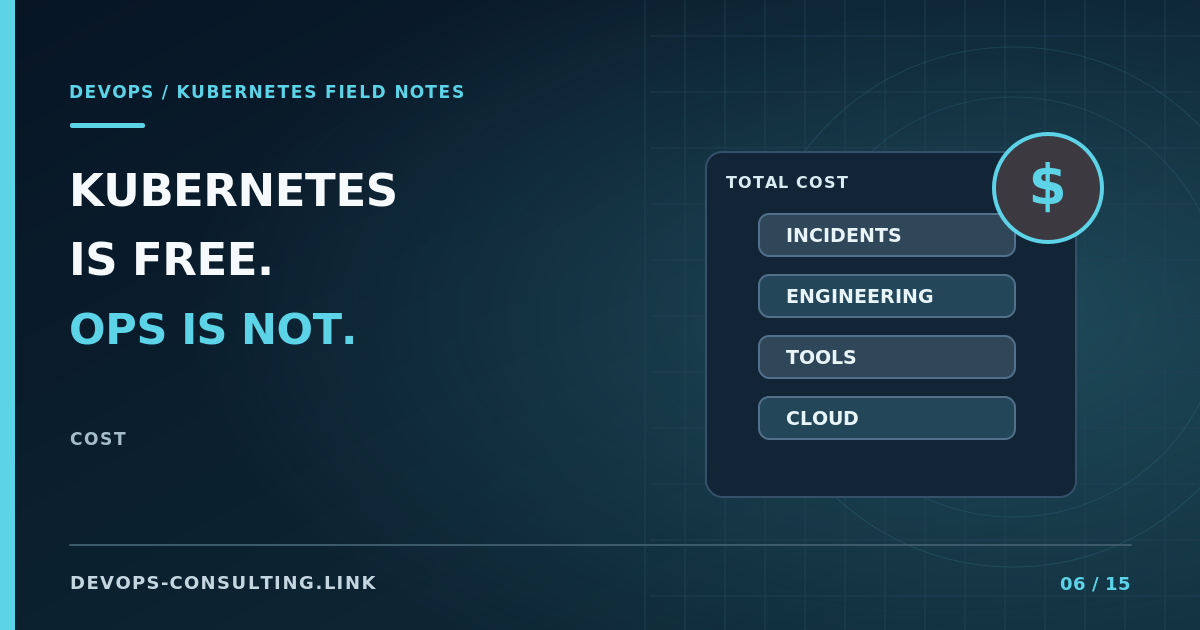
Kubernetes is open source. So are many of the tools around it. The software license can be zero while the operational bill keeps increasing.
I don't mean "Kubernetes is too expensive for everyone." I mean most infrastructure cost discussions leave out the cost of operating the infrastructure.
The bill you can see
Start with the obvious items: control-plane charges where your provider has them, worker nodes, persistent volumes, load balancers, data transfer, monitoring retention, and container registries. Add non-production environments, which frequently run all night despite being used only during working hours.
A cluster with low average CPU consumption can still need substantial node capacity. Kubernetes schedules based on resource requests, not average CPU usage. If requests are inflated, the cluster can look full to the scheduler while dashboards show unused compute.
The bill you don't see in cloud billing
Who patches the cluster? Who updates Helm charts and add-ons? Who investigates failing CNI upgrades, rotates certificates, reviews RBAC, and tests disaster recovery?
Those hours are real cost. So are interruptions: an application engineer blocked by a platform outage is not shipping customer features. A founder troubleshooting a node problem is not doing founder work.
One useful model is:
Total platform cost = infrastructure + engineering operations + tooling + incident impact + opportunity cost.
The last two terms are hard to calculate precisely. That doesn't make them zero.
Four places I look first for waste
- Oversized requests and idle capacity. Compare requested resources, actual utilization, and peak demand; don't simply remove limits or slash requests blindly.
- Non-production clusters. Ask whether idle environments can scale down safely outside business hours, without breaking scheduled work.
- Storage and networking. Unused disks, old snapshots, excessive log retention, and cross-zone or internet egress can quietly dominate the bill.
- Tools with duplicated jobs. Several monitoring or deployment layers may solve overlapping problems while multiplying maintenance effort.
Also examine cost by team, namespace, and workload. Tools such as OpenCost can help allocate Kubernetes expenses, but allocation is useful only if someone acts on the findings.
Do not optimize for the cheapest possible bill
Reducing replicas from three to one could save money while destroying your availability target. Cheap infrastructure that regularly takes production down is often very expensive business infrastructure.
The right target is cost per reliable, useful unit of service, within clear operational and business constraints.
Discussion: What's the largest Kubernetes cost your company doesn't measure: compute waste, engineering time, or incidents?
If your cluster is expensive or difficult to operate, a Kubernetes Cluster Audit can establish a practical baseline. For broader architecture work, request a discovery call.